All posts tagged: England

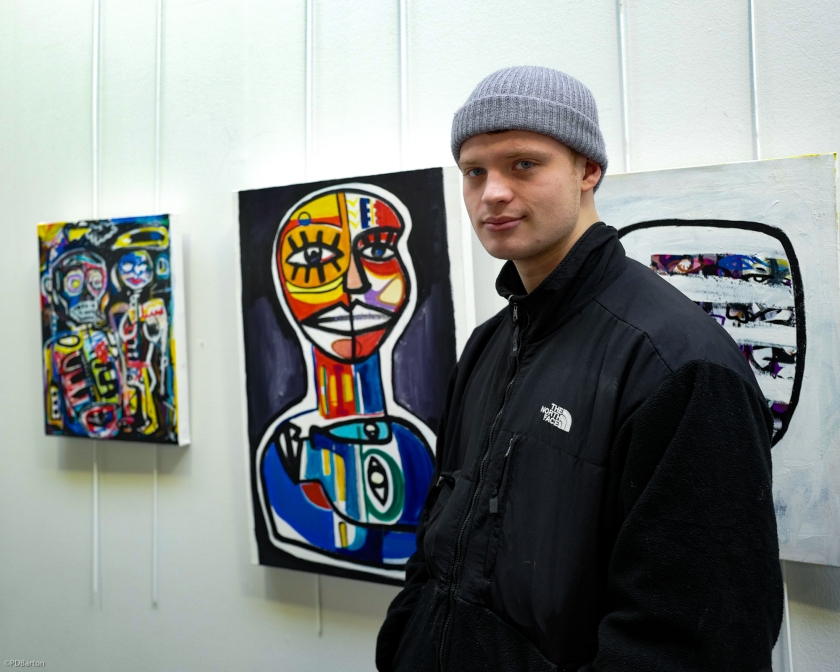
Vibrant art in Lincoln Gallery.

An exhibition of picture by the artist Jacob Lawson opened in the Sam Scorer Gallery in Lincoln this week. It’s hard to believe this is Jacob’s first show. What is not hard to believe is the work is strong, strident and selling well, The first images were snapped up by a buyer from Germany. This is a must see show. Be ready for an overload for the eye. If there is one criticism it would be there is simply too much. Go to see if you can. The show is open until 4pm on the 22nd December. You can find information about Jacob, his work and the gallery here… Sam Scorer Gallery. Lincoln   PDBarton. Lincoln, 16th December 2019.  

Barristers. Lincoln Castle.

Lincoln castle sits high on Lincoln Edge, overlooking the city. Within the space created by the  Norman curtain wall defences of the castle there is an early Victorian Prison, now disused, and a building housing Law Courts. The law courts are still in use. It’s not at all unusual to see prison vans delivering those who are about to be put on trial lined up, within the walls, at the back of the law courts. It was a sunny day towards the end of September 2019. I was walking the circuit along the top of the castle wall. Looking down into the castle I saw a couple of Barristers discussing a case, probably with their instructing solicitor. PDBarton Lincoln 2019

Boston 2018

A picture taken in Boston, near to St Botolphs church, aka Boston Stump. This image was originally taken as part of a series  I was making about the meridian as it passes through Lincolnshire. However, it does have carryover to other series; for example the series on dumped furniture and another on reduced landscapes. The abstraction of what I saw appealed to me greatly. PDBarton November 2019

All change, yet again.

I was in Birmingham last week, the city of my birth. And just to remove any confusion, I’m talking of Birmingham in the West Midlands of England. Every time I visit there has been change. The city seems incapable of standing still for just one minute. Perhaps that’s how it should be, afterall, Birmingham is known as the driver behind the industrial revolution of the 18th and 19thC. and was for many years, the home of manufacturing in the UK earning it the aphorism of “The City of a Thousand Trades”. It’s not an old city. Its growth, fed by the industrial revolution, came as a result of hundreds of thousands of ‘immigrants’ from the farming communities in surrounding counties. My own forebears on both sides were “Aglabs”, agricultural labourers, from Staffordshire, Warwickshire, Gloucestershire, together with true ‘immigrants’ from Ireland. Birmingham is a crucible, and always has been. With that growth comes continual change. As a reason for change, added to that of growth, is development – in the shape of technology, working methods etc. …

Just a little of Birmingham’s brutalist architecture.

Three Brutalist building in Birmingham. Two of which have gone. The first is the now-demolished Birmingham Central Reference Library designed by John Madin and constructed in 1974. It lasted 41 years before its recent destruction. The second is the signal box at New St Station (comprising 2 images), designed by Bicknell & Hamilton and W.R. Healey and completed in 1965. This is listed and so remains. The third is 103 Colmore Row, the Nat West Tower, as it was known. Designed by John Madin. It opened in 1975.  It was demolished in 2015-16 and is to be replaced by another, taller tower.

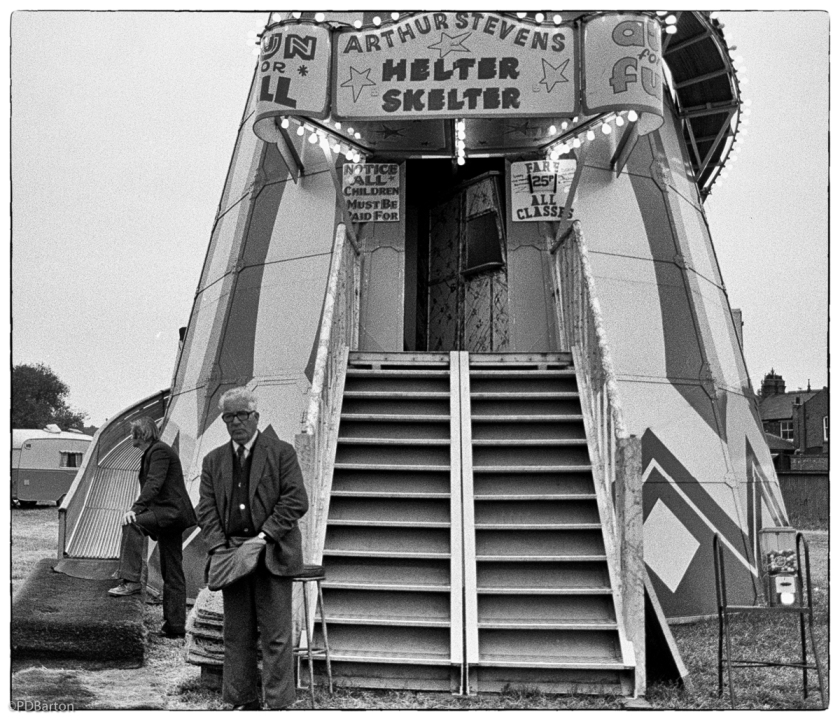
Fairground attraction 1970’s

Back in the late 1970’s, I would wander around my home city of Birmingham, camera in hand. At the time it was all Black-and-White work, self-developed and printed in a makeshift darkroom. I had different cameras to choose from, nothing exotic. I used twin lens reflex and 35mm. These images were from my 35mm camera probably on *400asa film hence the grain. *(I must check as I have the original negatives somewhere) The images below were from a sojourn to an impromptu fairground, many popped up like this around the city. This one appeared in Hay Mills, adjacent to the A45 near to Small Heath.

Differing opinions.

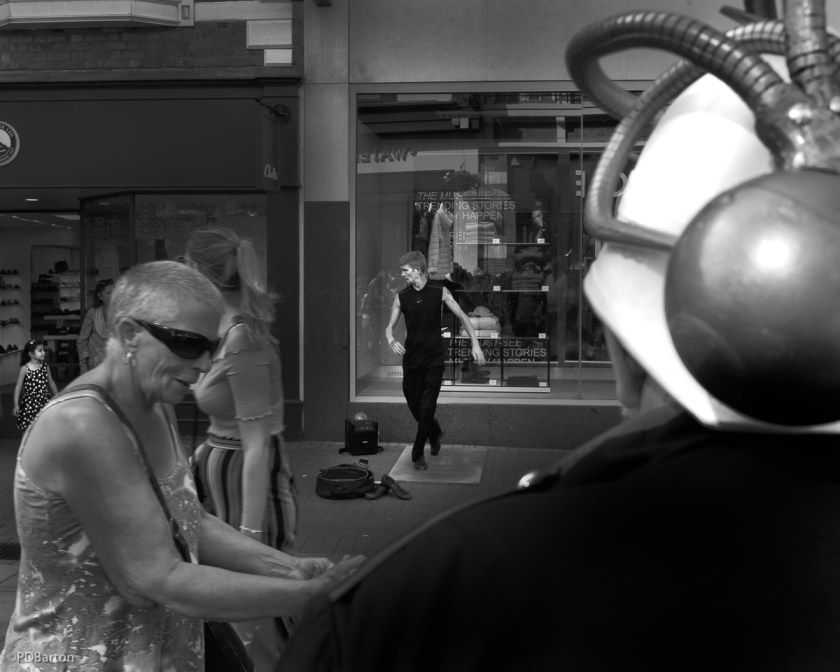
For me, a satisfying image has shapes and layers. I was at the SteamPunk festival in Lincoln on Saturday. This image was from the lower half of the city (where there were fewer SteamPunk attendees). I was drawn by the incongruous hat of the SteamPunker – a white military helmet surmounted and enclosed by an Octopus. I use that as the front layer and slightly out of focus, with shoppers passing in the next layer.  The layer which first attracted me contains the Irish Dance Busker making eye contact with the delighted little girl.  Finally, in the last layer of interest is the shop attendant peering out of the window. I find this image satisfying even though it’s far from perfect containing as it does elements others may believe detract from the image. As you maybe aware, my images are just for me so you may not agree. That’s OK. That’s what makes this art form so interesting – alternative views of the same thing and differing opinions.

Full Circle.

An exhibition of Images by Emma Bowater and James Millichamp. Taking their inspiration and source images from the built environment, particularly urban decay and dereliction these two artists have worked to produce the images for this show. At first glance, you would imagine this exhibition is by one artist, such is the consanguinity of their approach to the work and the resulting images. The exhibition notes speak about their images much better than I could, so… “We have always shared a fascination for the built environment, and particularly urban decay and dereliction. Over the past year we have been working together to exploit this theme through various processes, cross-pollinating and stimulating each other’s practice. Through painting, drawing, print and cyanotype we aim to capture the atmosphere of a space, alluding to the history lost through the process of decay. A disused building can act as a symbol for the temporaneous nature of mans’ achievements, or as a metaphor for emotional abandonment. Through the works, we seek to document the vacant and transient environments of architecture. …