Latest Posts

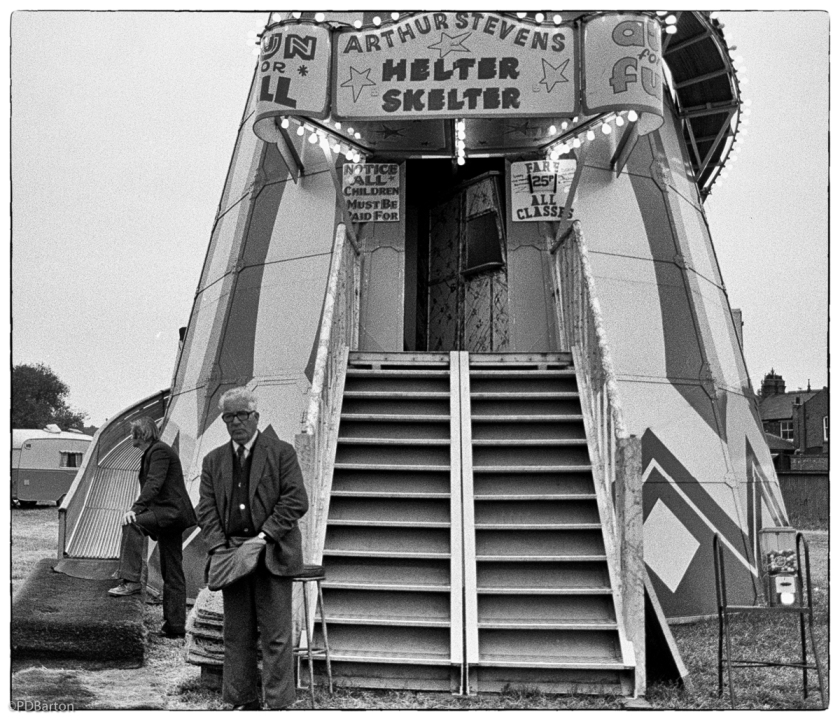
Fairground attraction 1970’s

Back in the late 1970’s, I would wander around my home city of Birmingham, camera in hand.

At the time it was all Black-and-White work, self-developed and printed in a makeshift darkroom. I had different cameras to choose from, nothing exotic. I used twin lens reflex and 35mm. These images were from my 35mm camera probably on *400asa film hence the grain.
*(I must check as I have the original negatives somewhere)

The images below were from a sojourn to an impromptu fairground, many popped up like this around the city. This one appeared in Hay Mills, adjacent to the A45 near to Small Heath.

-877-Edit-2-Edit-879-Edit-880-Edit-878-Edit-2-Edit-881-Edit-876-Edit-2-Edit-Edit

Differing opinions.

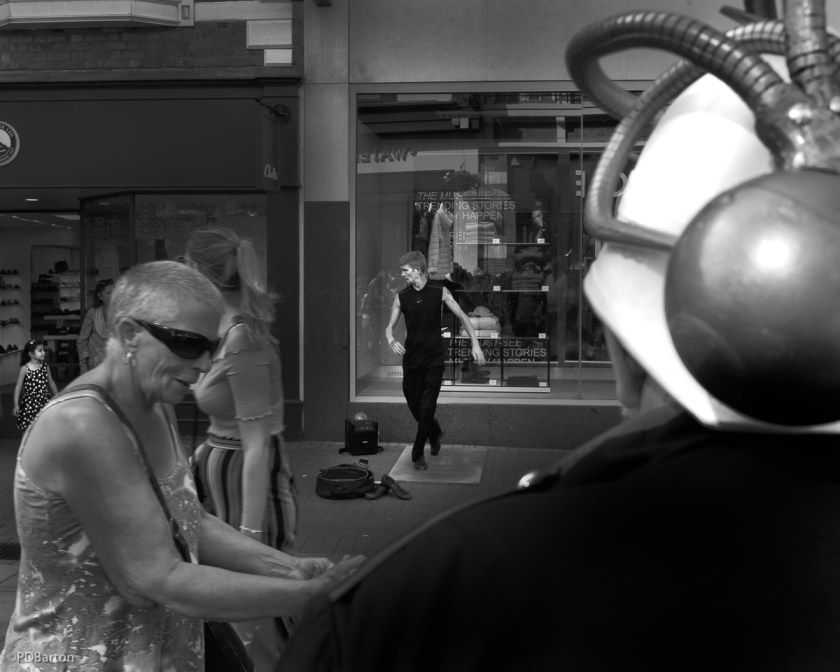
For me, a satisfying image has shapes and layers.

I was at the SteamPunk festival in Lincoln on Saturday. This image was from the lower half of the city (where there were fewer SteamPunk attendees).

I was drawn by the incongruous hat of the SteamPunker – a white military helmet surmounted and enclosed by an Octopus. I use that as the front layer and slightly out of focus, with shoppers passing in the next layer. 

The layer which first attracted me contains the Irish Dance Busker making eye contact with the delighted little girl. 

Finally, in the last layer of interest is the shop attendant peering out of the window.

I find this image satisfying even though it’s far from perfect containing as it does elements others may believe detract from the image.

As you maybe aware, my images are just for me so you may not agree. That’s OK. That’s what makes this art form so interesting – alternative views of the same thing and differing opinions.

Full Circle.

An exhibition of Images by Emma Bowater and James Millichamp.

Taking their inspiration and source images from the built environment, particularly urban decay and dereliction these two artists have worked to produce the images for this show.

At first glance, you would imagine this exhibition is by one artist, such is the consanguinity of their approach to the work and the resulting images.

The exhibition notes speak about their images much better than I could, so…

“We have always shared a fascination for the built environment, and particularly urban decay and dereliction. Over the past year we have been working together to exploit this theme through various processes, cross-pollinating and stimulating each other’s practice. Through painting, drawing, print and cyanotype we aim to capture the atmosphere of a space, alluding to the history lost through the process of decay. A disused building can act as a symbol for the temporaneous nature of mans’ achievements, or as a metaphor for emotional abandonment. Through the works, we seek to document the vacant and transient environments of architecture. Empty spaces, devoid of human life, freeze and reaffirm human existence. Detailing remaining relics of human presence, the images emphasise a sense of isolation and abandonment; echoing the emotional anxiety of absence.”

The show is well worth a visit. Go see if you can.

It’s running in the Digbeth Art Space Gibb St., Digbeth, Birmingham B9 4AT

ENDS… 2nd September 2019

Faded Grandeur.

In traditional Japanese aesthetics, wabi-sabi is a world view centred on the acceptance of transience and imperfection. The aesthetic is sometimes described as one of beauty that is “imperfect, impermanent, and incomplete.
Wikipedia.

I’m not sure this image shows that principle exactly, but somehow, the imperfection of dilapidation and the consequent transience has a beauty of its own, albeit the process has perhaps gone just too far.

Nevertheless, this image of an old French Colonial townhouse in Pondicherry, Southeast India, for me anyway, has a faded grandeur and a presence all of its own.

Peter Barton
July 2019


The Beautiful Error.

I visited an exhibition of striking work by photographer Katie Hallam in the delightful, bijou Gallery at St Martin’s, in Lincoln yesterday.

Katie is a degree qualified photographer. In her current work, she takes the structure of her initial pictures and re-works them to produce surprising and questioning images, turning them into strident artworks, full of energy and colour.

The concept explores glitches – errors if you will; hence the title of the show – momentary aberrations of the norm, be those glitches natural or induced, in order to create ‘another worldliness’ in exploring and dividing what is captured from what is seen.

The technique explores the manipulation of those glitches using alteration to the code producing those jpg digital files. The work dispels any doubt, if the is any, that photography is art*.

The work is exciting and is well worth seeing. Sadly it closes on the 13th July 2019 but you can see her work on her web site here.

https://www.thebeautifulerror.com

The image above is part of one of Katie’s images, who, of course, owns the copyright.
Katie can be contacted from her website or here…

thebeautifulerror@gmail.com

*When asked if photography is art, David Bailey delivered a pithy reply,

“Of course it’s fucking art”.

Skegness.

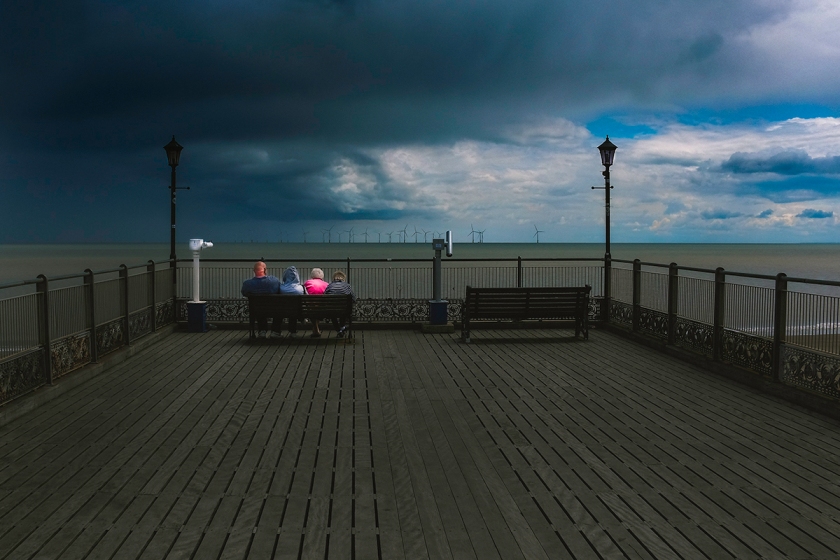
An image made in July 2014 on the pier at Skegness, Lincolnshire. This image has been very popular over on my Twitter account.

It shows a group of people occupying a bench at the end of the old (now truncated) pier as a storm rolls in from the North Sea over the offshore wind farm.

A visit to the Barbican in the City of London.

I don’t know about you, but I thought the Barbican in London was simply an arts centre – simply an Arts centre” there’s an understatement for a start. Just how wrong can you be?

ticketMy wife, Sue, knowing I like Brutalist architecture bought me a ticket for a guided architectural tour of the ‘complex’ and complex it is.

Not only is it an arts centre – by the way, this section of the development was finalised and built last – but it is a housing project comprising around 2000 flats. 

First, throw away all preconceptions of what a ‘housing project’ of this size would look like. The project was conceived in the late ’50s by architects, Chamberlin, Powell and Bon. They planned and delivered a high quality, wonderfully detailed living space, and due to the management of the terms of the letting or sale of the units, it has remained so ever since. Strict conditions apply regarding what the occupants can and cannot do –  but I’m getting in front of myself.
L1010816-Edit

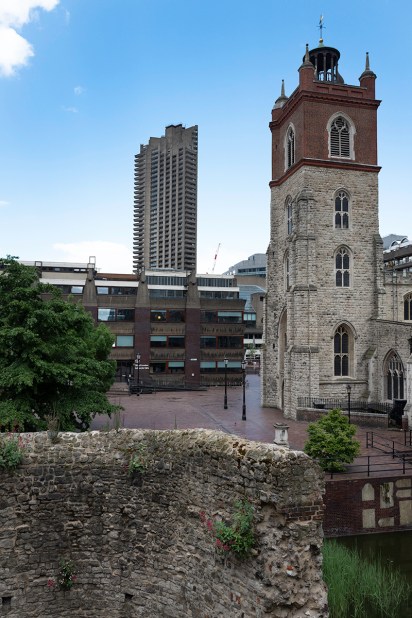
The church of St Giles without Cripplegate, one of only 2 buildings left in the area after the blitz. The stonework in the foreground is part of the remains of the original Roman fort.

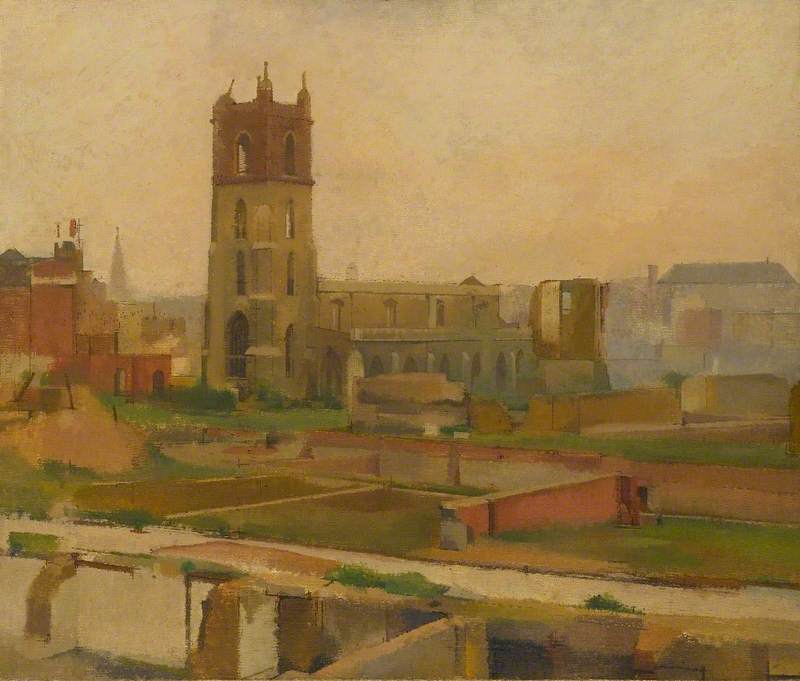
If I may backtrack; The area of CrippleGate in the City of London was bombed during WWII. Many lives were lost and most buildings in the area were destroyed completely or were beyond repair.


Coldstream, William Menzies, 1908-1987; Cripplegate

Cripplegate after the blitz painted by William Menzies​ Coldstream

After the war, in the late ’40s and ’50s plans were made to re-build and to repopulate the area. Chamberlin, Powell and Bon were asked to submit plans for the Barbican – they were building the nearby Golden Lane Estate. Construction began on the residential blocks in 1963, the Barbican arts centre followed some time later.

The architects eschewed the label of “Brutalism” for their designs, although there are many elements of Brutalism in the concepts and delivery of the architecture. Their choice of a less than formal Brutalism allowed them the freedom to soften the structure – as in the Conservatory where the use of planted areas soften the raw concrete Fly Tower of the theatre rising from below.

The simple yet effective, startling even, technique of designing the project ‘Inside Out’ as it were, where flats faced inwards on to large courtyard gardens and planted areas, give the whole thing a hidden, secret garden feel. My first thought on entering was “This is not what I expected”. Look at the pictures and judge for yourself.

To an ex-construction surveyor/engineer like myself, this is a polished jewel of craftsmanship. The detailing achieved by the architects pervades from the massive and grand scale of the structure down to the human level where you ‘touch’ excellent craftsmanship and fine (and expensive) detail. These are not buildings where money has been spared.

I won’t bang on about the quality of the concrete work or just how unbelievingly difficult that was to achieve. No matter what you may think ‘concrete is not just concrete’. Yes if it’s structural and is going to be covered you can be less careful about what it looks like but when it’s all exposed like this… just getting the colour consistent is a major problem for the mixing and pouring gangs. What they achieved is no mean feat I can assure you.

“Just getting the colour of the concrete to be consistent throughout the project must have been a major problem”

OK… you may not be interested in the technical aspects of the construction – or how the engineers maintained consistency in the concrete, just don’t take the process for granted. What has been achieved here is a masterpiece in design and execution, a monument to excellence in the ability of the architects and workforce alike. Just stand in the spaces. You will understand.

“Book a tour. It really is worth it.”

As for buying one of these apartments, and I would love to, the ordinary man would have to win the lottery. They are hugely pricey (£1million and up) – though apparently, you can rent, though even to do that is eye-wateringly expensive I understand.

TO DISCOVER MORE…

There are a couple of good web sites to see…

1. First, to book your ticket – AND YOU REALLY SHOULD – go here…

https://www.barbican.org.uk/whats-on/2019/event/architecture-tours

2. And if you want to look inside the flats… well, you can’t, not physically anyway, but this excellent site takes you inside some of the flats and meets the residents…

Barbican residents

A visit to the Barbican is a must for anybody interested in post-war design.

PICTURES

L1010818-Edit

The brick building in the near distance is, in fact, a concealed stairwell between the car parks below and the podium level.
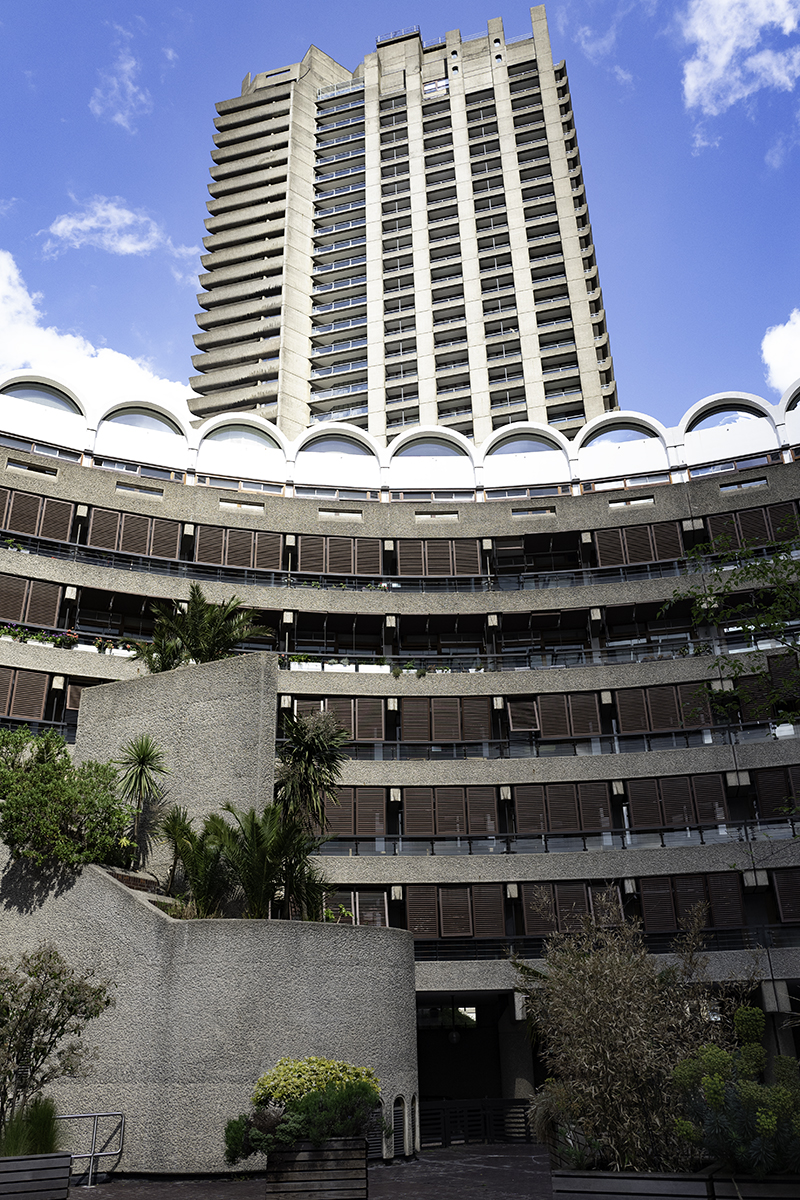
L1010826-Edit

The semi-circle design device used again around an outdoor performance area, which is itself the roof of the interior performance area below.

L1010807-Edit-Edit

Smooth Terrazo and hand roughened tooled concrete textures in the circulation areas of the Arts Centre.

L1010802-Edit

Subtle, sophisticated detail used in the Terrazo finishes to walls and floors in the men’s toilets

DSC01097-Edit

Elements of Brutalism are used in all three towers (one 43 floors and two 42 floors)
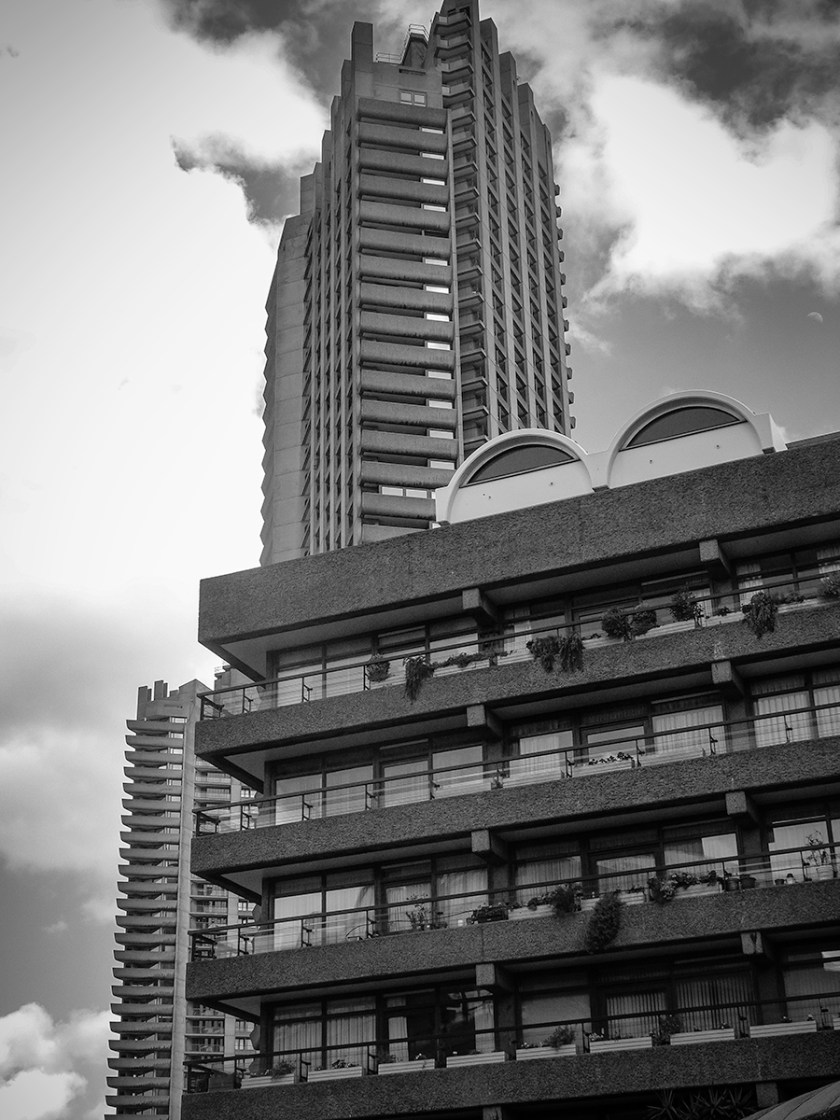
DSC01100-Edit

The recurring use of the semi-circle reflecting the shape of the old Roman fort

DSC01096-Edit

Elements of Brutalism are used in all three towers (one 43 floors and two 42 floors)

I can’t move the sun, and it’s always in the wrong place

I’m going to start this piece by declaring that, at no time in my life have I ever been a trainspotter or engine enthusiast. No, it’s not that particular obsession which feeds my appreciation of the technical ability and art of O. Winston Linkwho?

Ogle Winston Link  (1914 – 2001) was an American photographer, originally from Brooklyn, New York City. Introduced to photography as a boy by his father, Link went on to achieve a degree in Civil Engineering. Whilst at the Polytechnic Institute of Brooklyn he served as ‘photo editor’ for the institutes’ newspaper. He later moved into photography proper.

Link had a longstanding love of railroads (probably resulting from his training as a Civil Engineer), particularly steam, which became sharply focused by the impending conversion of the railroads to Diesel power in the mid-’50s. Link became heavily involved with the Norfolk and Western Railway (N&W) one of the last steam railroads in America.

Link’s work was self-financed, though he was encouraged by N&W officials from the President of the railroad downward. He had full access to all areas.

However, let’s not dwell too much on the railroad aspect per se, though of course, it is the main subject of his work. No, it is the sheer technical excellence of his work which floored me when I first came across it.

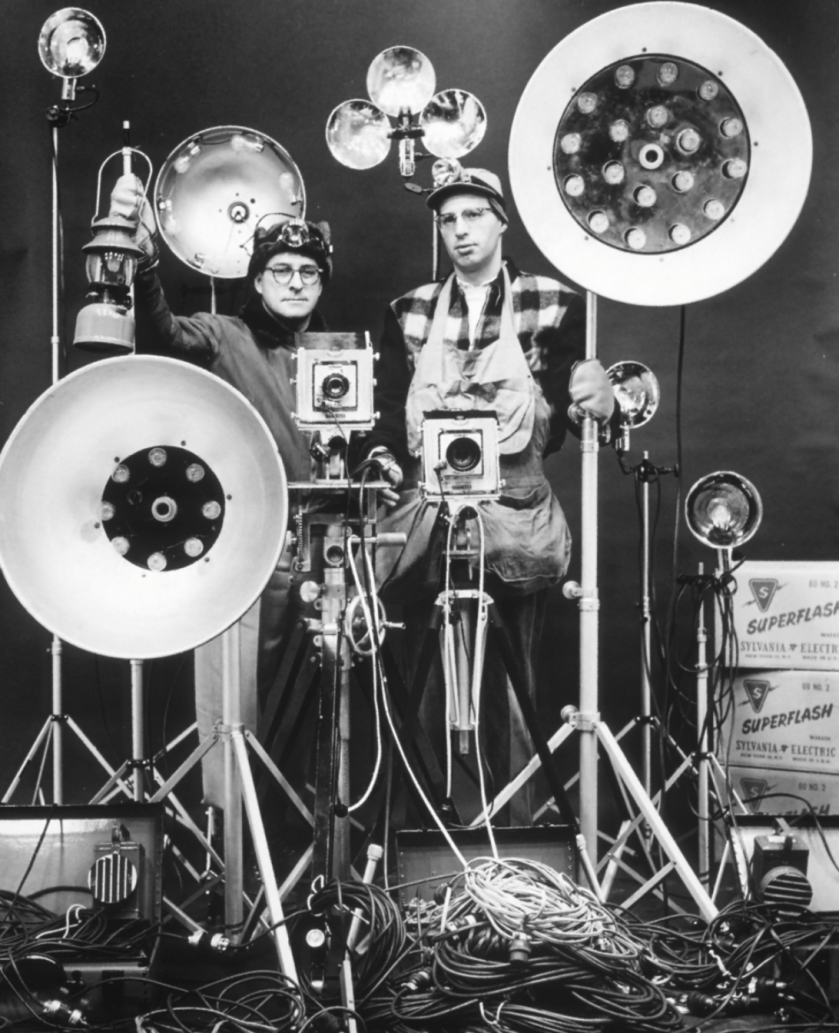
For anyone who has struggled with any form of lighting, even using a simple set up, Link’s work is a majestic tour de force of lighting, it is simply brilliant if you will forgive the pun.
Together with his assistant, he used banks of flash and wiring for light, sometimes dozens of flash heads and bulbs were used to achieve perfect exposures of not only the rolling stock but the environs through which they passed – providing, as he did, social comment in so doing.

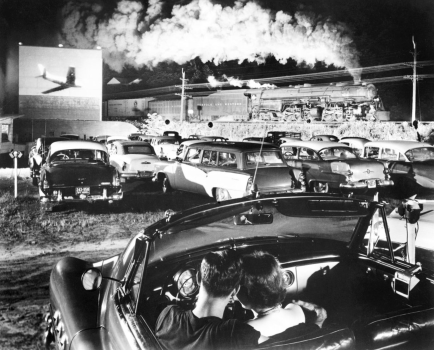
The classic image demonstrating his mastery is the image of an engine the “Hotshot Eastbound” taken in a drive-in movie theatre in Virginia.
Screenshot 2019-05-06 at 09.55.19The image is sharp and well lit from the very close foreground to the engine passing in the far distance – and all without ‘blowing out’ the movie screen showing an aircraft. Brilliant.


Screenshot 2019-05-06 at 09.58.12

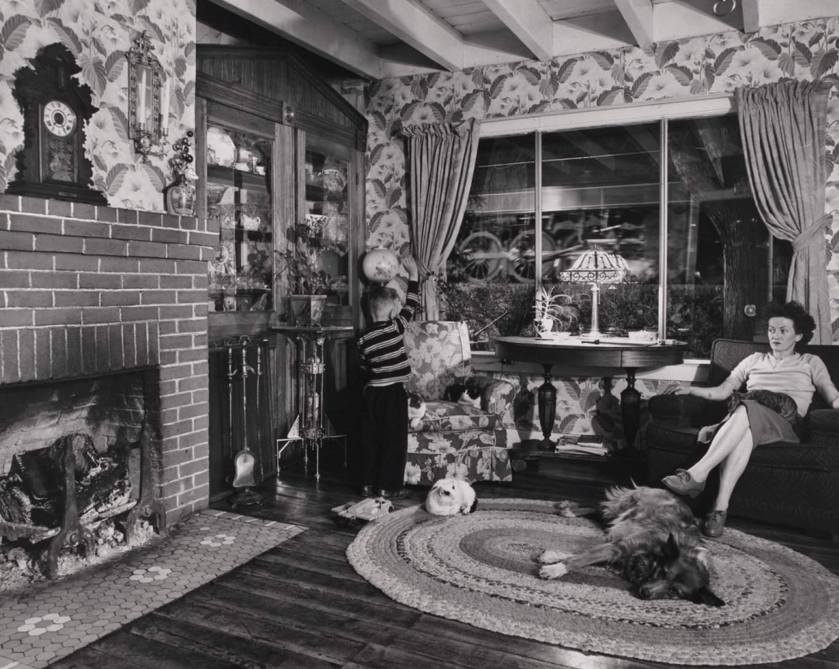
An interior​ shot of a 1950’s house with people. The internal lighting and the externally lit steam loco in perfect balance.

Asked why he took his pictures at night he said…

“I can’t move the sun — and it’s always in the wrong place — and I can’t even move the tracks, so I had to create my own environment through lighting.”

Links later personal life was ‘unfortunate’ with his 2nd wife being imprisoned for selling his pictures. Nevertheless, Link will be remembered for his mid 50’s nighttime shots showing ‘small town / big steam’ America. An evocative series of images of a time long gone.

For anyone who wishes to see technical excellence coupled with 1950’s social interest then his books are a must – whether you like trains or not they are a joy.

Amazon has some a selection online here…

BOOKS BY  O. WINSTON LINK.