A few weeks ago we were notified by Anglian Water we had a water leak and that we had a month or so to fix it, or else.
We investigated inside the house. Nothing was found. No leaks at all. Everything was dry.
We called the number on the e-mail and a really helpful chap arrived from Anglian Water to see if he could find the leak externally saying “It may be the connection between your house and our main”. Reassuringly adding “in most cases it is”.
He called in an “Emergency team” to dig up the pavement around the stop tap point where we are connected to the main. They came, they dug and found the connection to the main was not the problem. At the same time they upgraded the connection point to their main.
It’s worth mentioning here:
1. Anything in the pavement is their issue not the householders.
2. Anything from the back of pavement into the house is the responsibility of the householders to fix.
Hmmm that sounds expensive we thought.
Anglian thought the leak was small, just a few hundred litres a day. Small! That seemed like a lot to us. (b.t.w. it got worse)
We had a number of very helpful employees from Anglian Water come to visit us to explain what the problem was and advise us how it may be fixed.
Many older houses would have had lead piping providing the connection between the house and the water main under the footpath. Our house built in the 70’s had a black plastic pipe made from Alkathene, lead having been phased out long before. According to the various employees from Anglian Water who visited us these older Alkathene pipes are notorious for splitting and leaking.
But how does the plastic pipe get from the side of the road to our internal stop tap which was underneath the bath in the centre of the house? Where had those 1970’s builders ran the pipe?
We suspect it had been placed under the floor slab during construction. This would make replacing the Black Alkathene with new plastic piping nigh on impossible. Hmmm.
(B.T.W. We live in a bungalow so everything is at ground level).
What about paying for this? Can we claim it on insurance? It transpires you can claim for a repair to the water supply but not to replace it.
Yes, I suppose we could have had the position of the leak identified and just had that piece “repaired” under the insurance policy. However, the pipe having failed once is likely to fail again. Replacement seemed the proper answer.
The best piece of information given to us by one of the Anglian Water team who called on us was “Our feed does not have to be connected to the position of the old stop tap. It can be connected to any of the cold water pipes in the house.” We didn’t know that.
For us this meant we could allow the feed to come to the front of the house. Our plumber could then take it up into the roof and connect relatively easily to the cold water system in the roof.
What this meant is we needed a relatively short run of excavation between the pavement and the house, just over 6m.
N.B. It is a legal requirement to have the pipe buried to a depth of 750mm or more (For frost protection).
This excavation would have to go across a lawn, through/under low brick edging to the lawn and then through block paving. I did not relish digging this myself. I’m far too old for that.
It was suggested we could have this “Moled”, that is where a pneumatically powered mole could provide the connection between pavement and house wall, with minimal disturbance. We were sceptical. After some research we discovered a local Lincoln based company specialising in this type of work.
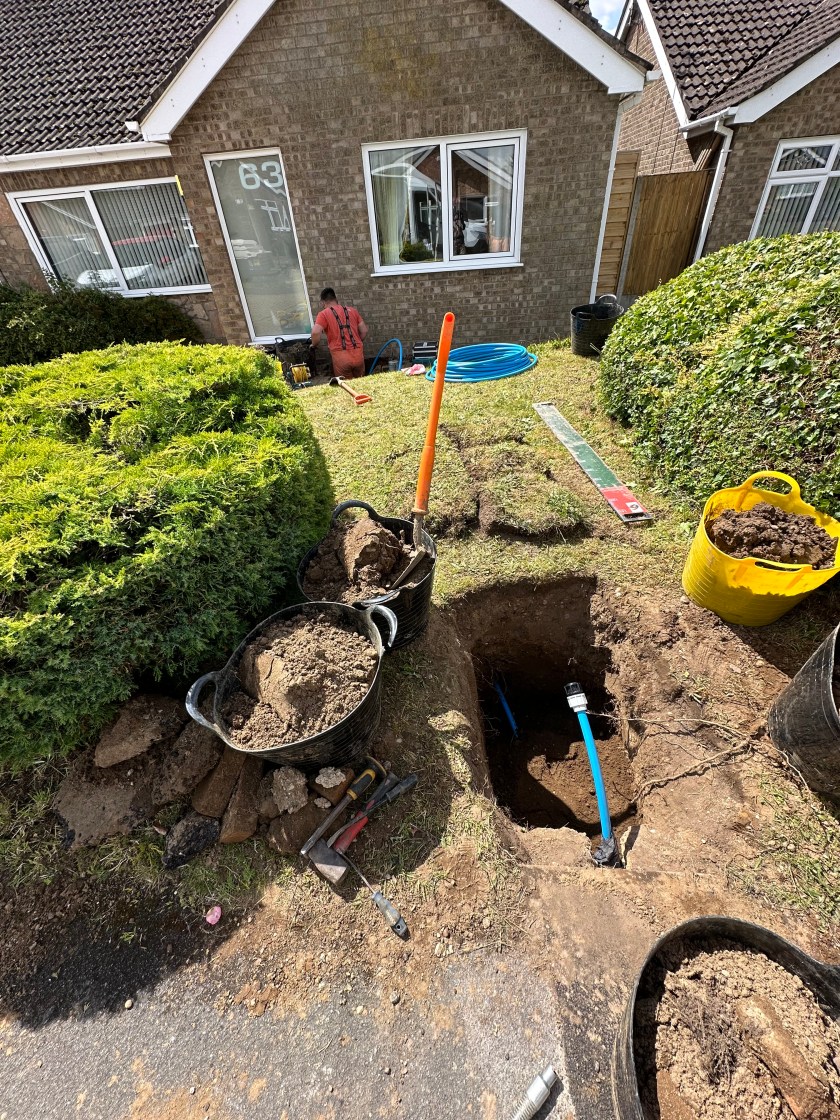
They started by hand digging 2 pits. One at the water main end of the proposed run and other at the house end. These pits were about 750mm square and were to the required depth. Next, the Mole was made ready and targeted, aiming from one pit to the other. The air compressor was started and the Mole was set on its way underground between the pits. It didn’t take many minutes before the Mole appeared in the target pit, in the right position. The Mole was removed and the new water pipe was pulled back through the hole it had made.
See foot of page for 3 videos of the Moling process
The same company then drilled the wall of the house just above floor level.
You can see the new supply blue pipe inserted after the Moling process, ready to be connected.
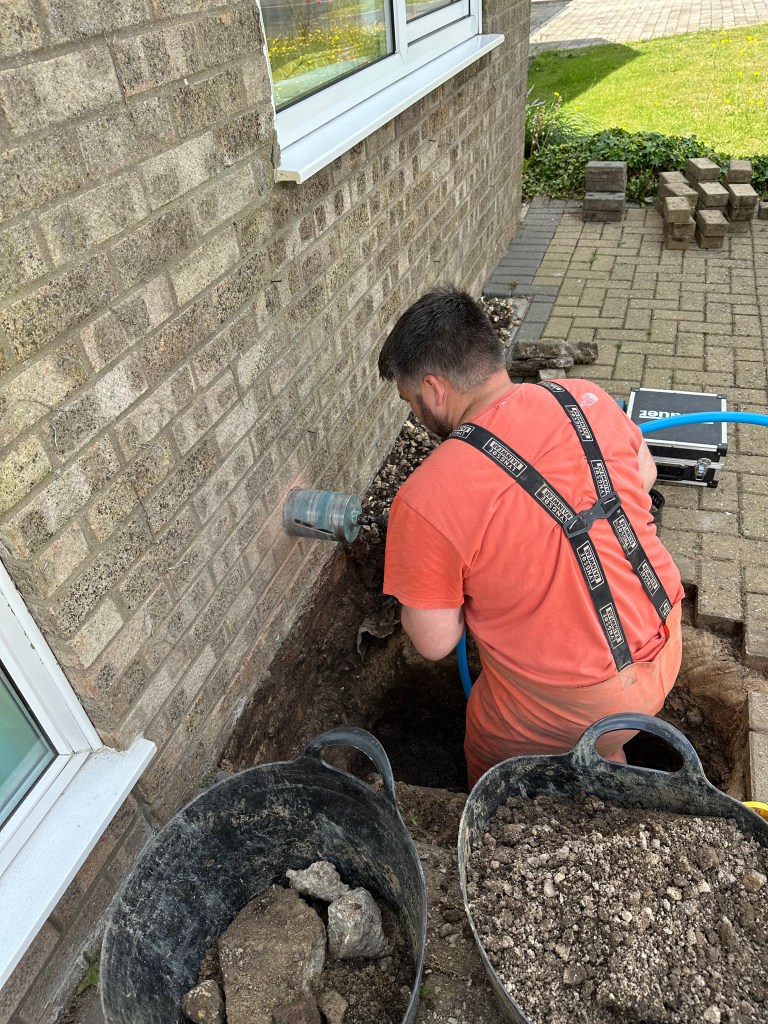
In order to comply with insulation requirements the new water supply was then contained in a proprietary insulated box from the base of the trench up to the newly drilled hole.
(n.b. the hole is 100mm dia so as to allow for the new pipe to be insulated as it passes through the wall to the inside of the house.)

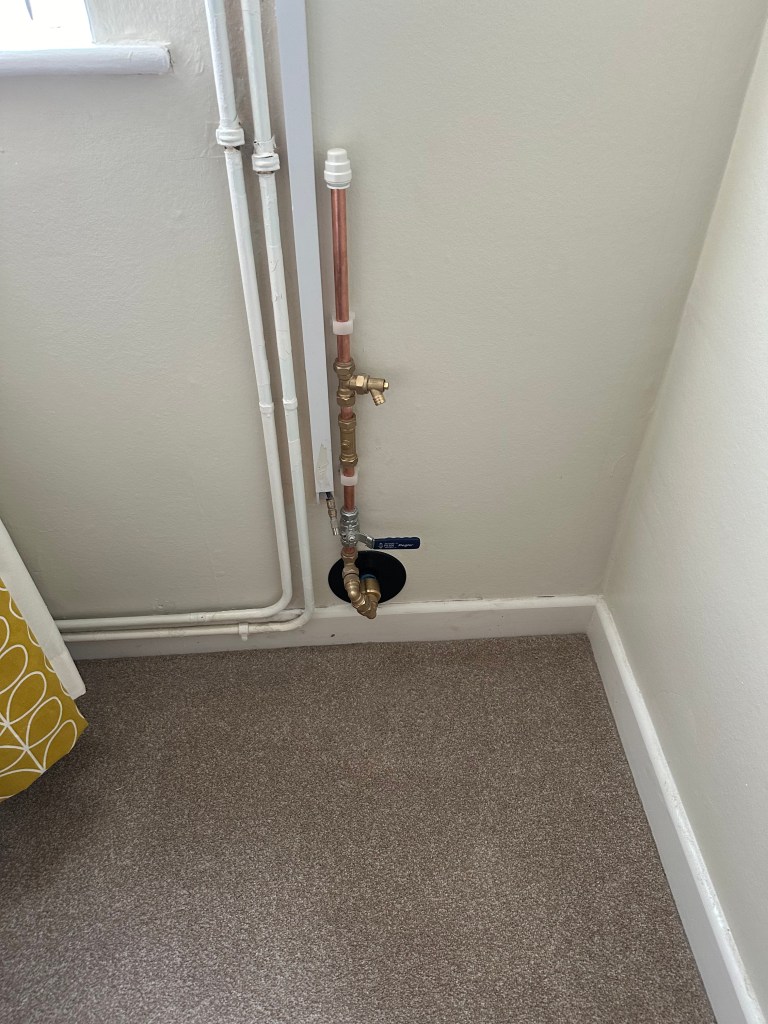
Once inside the house the new pipe was terminated with a stop tap, a non return valve and a drain tap, all of these are required by the Water Authority. A tail was left for our plumber to connect to for the internal works.
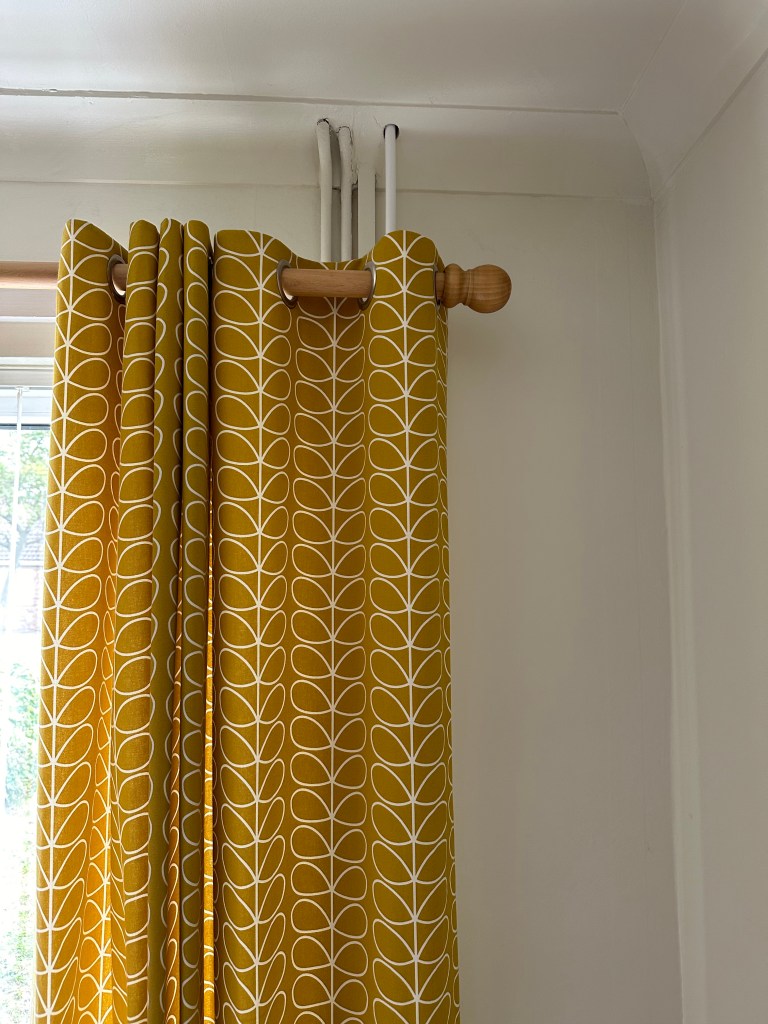
Once connected to the internal plumbing the long curtains we have in that bedroom covered the pipework.
We cannot speak highly enough of the assistance we received from the representatives of Anglian Water who dealt with us before, during and after the works. However, we reserve our highest praise for the team from SR Water & Civils whose work was simply exemplary, even down to the restoration of the block paving they had to remove for one of the pits to be dug. Simply excellent.
Now, a few weeks on from the start of these troubles, we have a new water supply to the house, our plumber has made the internal connection, clean fresh water is flowing, we don’t have large tubs of water sitting in the bath (for when supplies needed to be disconnected) and we are not wasting nearly 3000 litres of water per day caused by the leak.
Our thanks go to:-
- Anglian Water Leaks Team
- S R Water & Civils for installing the new pipework and the rest of their excellent work.
Contact details:-
SR Water & Civils
26 Gloucester Close
Bracebridge Heath
Lincoln LN4 2TB
07961 158487 - James Morley our long suffering, and long term plumber (James has worked with us 27 years now) for the excellent internal plumbing on this replacement water supply project.
A few sundry images of the aftermath – from left to right…
1. The new tail of blue pipe ready for Anglian Water to come and make the connection to the main.
2. The top end of the box containing the insulated pipe.
3. The relaid block paving. You wouldn’t know they had been.
4. Our existing curtain hiding the internal works.
5. The new plumbing connecting the new works to the existing cold water pipes in the roof. (right hand pipe)


Videos of the Moling process.
After targeting, the compressed air mole is set off towards the target pit 6 metres away.
The mole now heading towards the red and white ranging pole in the target pit against the house wall.
Interested neighbours discussing the process with the contractors as the mole approaches and breaks through into the target trench. Right on target.
END
 peterdbarton.com